
How have business models and their innovations evolved over the past 25 years? What is a business model? How do I innovate the business model? How will I leverage AI-based business model innovation in 2026?
1. Year 2000
The year 2000 was the time of the global ICT bubble. There were long queues on the streets of Helsinki, Finland, as people queued for shares in small ICT-based startups. In other words, the companies were about to go public. At that time, the world-famous innovation researcher, professor, and consultant, Gary Hamel, published the book “Leading the Revolution“, in which he presented a theory of the internet revolution. That revolution would change all the old business models. A new on-line economy would emerge that would no longer follow the old rules in any way – cars would be ordered directly online according to customers’ own plans and delivered directly to their homes in three weeks. The concept of “business model innovation” was born in innovation activities. The most important target of innovation would be the business model instead of the offering.
What happened? In 2001, the ICT bubble burst. Startups lost their value. The entrepreneurs were sued for violating insider regulations. The entrepreneurs who bought Lamborghinis and presented them in television studios lost their fortunes. Gary Hamel published his next book, titled “What Matters Now?”
In 2006, I was at a seminar organised by Tekes, Finnis Public Agency for Technology Funding, to listen to Professor Yrjö Neuvo, a former member of Nokia’s dream team. He presented the definition of innovation as follows: Innovation = Technology + Business Model. He had realised that there is always a need for a business model. He had also realised that more and more innovation activities are focused on the business model instead of technology.
What happened? Nokia achieved the best result in its history in 2007. That same year, the iPhone was announced. That was the beginning of Nokia’s downfall. The business model of the iPhone won.
3. Year 2013
In 2013, Professor Oliver Gassmann of the University of St. Gallen published his world-famous study “Business Model Navigator“. Together with his research group, he analysed 250 different business cases over a period of 25 years and classified the business models of these companies in 55 different ways. He modeled a process for developing new business models using all the understanding we have accumulated from them over the past 25 years.
What happened? The debate on business model innovation reached a certain maturity point. Hamel’s value lies in the fact that he brought business models into the sphere of innovation and presented a vision of what digitalization will enable. Now, 20 years after his prophecy, we see it come true. Global digital platforms are truly changing business models – data has become a commodity.
4. From Year 2022 to Year 2026
In 2022, on November 30, OpenAI announced ChatGPT. Since then, AI has been one of the most used letter combinations in business and in people’s personal lives.
Cyril Bouquet, a professor at the Swiss IMD, published an article in the latest HBR, 1-2/2026: “Match Your AI Strategy to Your Organisation’s Reality“. He starts the article from 2018 and gives examples of the use of AI in General Motors and Apple. At GM, AI developed an entirely new type of seat mount that was 40% lighter and 20% stronger than the previous ones. This was never put into production. Why, no? GM’s business model and subcontracting chain were not able to implement this structure. At the same time, at Apple, AI developed a so-called “Artificial Intelligence” system. to replace the traditional camera lens. The required production technology required the integration of machine learning, materials science, and semiconductor technology. After dozens of patents, the technology was first introduced on the iPad Pro and on 9 September 2025 on the iPhone 17. Why, yes? Apple not only had an idea, but also a business model and a system to implement it.
Today, in 2026, the challenge is not what AI can or cannot do? The challenge lies in the mismatch between what leaders would like to achieve and what their companies’ business models, value chains, operational models and technological opportunities realistically are.
5. AI-based Business Model Innovation 2026?
My teacher and guru, Stanford professor Larry Leifer said to me: “Pekka, there are plenty of answers, but focus on asking the right questions!”.
The right question is: What does business model innovation mean in 2026?
The business model has three main entities: value proposition, value capture and value creation.
- A value proposition is a promise to the customer and the final user. This is the value we bring to you.
- Value capture includes all the activities we use to ensure that we do profitable business ourselves: Who are the customers? What are the distribution channels? What is our customer relationship like? What kind of effects and experiences do we create for ourselves? What is the profitability of our own business? What is the profitability of the different parts we offer? How do we price what we offer?
- Value creation includes all the activities that we use to produce the value we promise: What are our core resources? What is our core function and process? What is our cost structure? What is our ability to renew our business model? What is our ability to leverage AI.
Business Model Innovation Guidance (see image below)
- Consider the business model as a whole:
- Am I targeting innovation to develop the dynamics of the entire business model?
- Consider the components of the business model:
- Should I focus my innovation on the development of a detail?
- Consider business models in your value chain:
- What is my customer’s business model?
- Consider business models in your value chain:
- What is the end-user business model of my value chain?
- Consider business models in your value chain:
- What is my subcontractor’s business model?
- Consider the business models in your ecosystem:
- What is the common business model of the entire ecosystem?
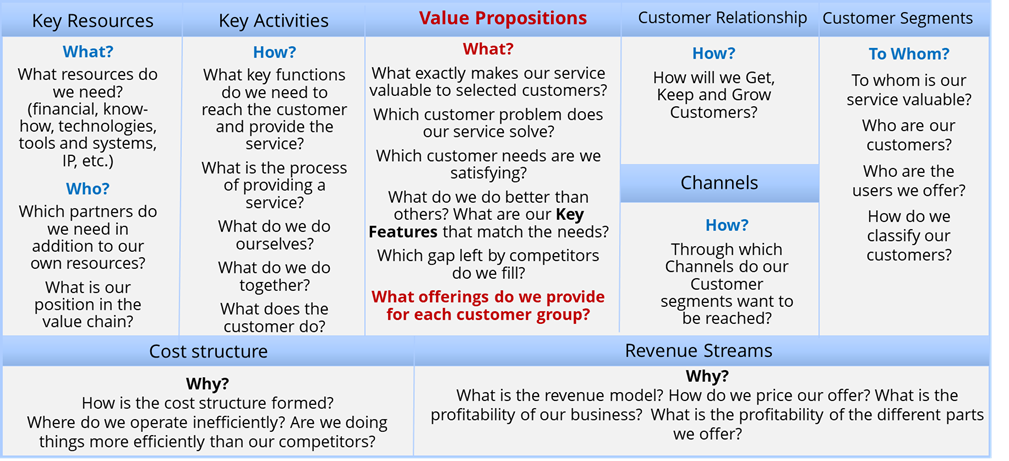
Picture: Aspects of the business model. Adapted from Osterwalder’s Business Model Canvas