
How have innovation ecosystems evolved over the past 25 years?
What kind of is the most powerful innovation ecosystem?
How do I innovate the innovation ecosystem?
How will I utilise AI in the development of next generation innovation ecosystems beyond 2030?
Mission of this blog
In the future, the ability to innovate and develop new offerings will become the the most important thing of success. In the following, I will examine this competence from four different perspectives:
- We need expertise to understand what innovation is.
- We need creativity and the ability to implement the different areas of innovation activity.
- We also need to understand not only the operations of our own company and organisation, but also the dynamics of the entire innovation ecosystem and our position in the ecosystem.
- In addition we have to create new AI-based next generation innovation ecosystems beyond 2030
1. What is innovation and what means innovation process?
The innovation process enables activities to develop new products, services and business models. The innovation process is typically divided into three phases: the initial phase, the development phase and the commercialisation phase.
From the perspective of the business environment, it is essential to understand what is happening in the world now and in the future. There are systematic methods and sources of information for gaining understanding, such as different business intelligence approaches, foresight, scenario work and market understanding. Strategic understanding is more developed the more it is able to proactively take into account changes in the business environment. How many people were surprised by the recent collapse of the Soviet Union? Have we understood how profoundly climate change is changing the world and consumer attitudes? I have met far too many frustrated R&D leaders who do not receive sufficient strategic support from the business management for their operations. In recent years, a few organizations, such as Tikkurila and Ahlstrom, have appointed a Chief Innovation Officer, which has been an excellent model for linking product development and business management.
2. Innovation activities need people
The process can be drawn on paper and filed in an engineer-like manner one brick at a time, but this does not guarantee the desired result. In the early 2000s, Christoph Loch, a professor at the French INSEAD, found out that only one third of the results of product development in the automotive industry were created in accordance with the official product development process. The second third came from management pet projects and the third third from informal projects. Significantly, these three different ways were equally successful. This phenomenon shows that innovation requires both formal and informal action (Loch 2000, ”Tailoring product development to strategy: case of a European technology manufacturer”)
I’m talking about enablers that are needed at the level of individuals, teams and organizations. The most important enabler is the social environment, i.e. people’s creativity and ability to execute. My clear observation is that there is usually no shortage of creativity, but people are basically full of ideas, competent and motivated, and genuinely want to develop something new. The bottleneck is often precisely the lack of executive capacity at different levels of the organization.
I have very good experiences of how enabling innovation activities improves when the company’s HR and change management are closely linked to it.
3. Leverage the entire innovation ecosystem
Above, I have discussed enabling innovation activities mainly from the perspective of one organisation. Nowadays, the role of networks is emphasised in all activities, including innovation activities. Previously, there was talk of networks, clusters and alliances. Now they also want to highlight the concept of ecosystem. All concepts refer to some degree of cooperation with a party outside the organization. Future competitiveness is increasingly created in innovation ecosystems. In the ecosystem, cooperative relationships and interdependence are even closer. It also offers new opportunities that a company would not be able to seize on its own.
An organization can create a competitive advantage at three different levels of the ecosystem. First, it can arise within the company in a closed system. Secondly, competitive advantage is created in an open environment where existing information is shared. This happens, for example, in teaching and consulting. The third level is the open creation of new knowledge in an ecosystem where different potentials, even very different potentials, meet freely. This third level creates a real competitive advantage. It is a winner that is able to build fast and agile platforms and operating models to involve different parties in development projects. Projects that bring together large companies, small companies, researchers and various public actors. (Mabogunje 1997, ”Measuring conceptual design process performance in mechanical engineering: A question based approach.”)
In the 1990s, I met Dr. Ade Mabogunje, a Nigerian-born innovation researcher at Stanford University in Silicon Valley. The three levels of the ecosystem presented above were presented by Ade Mabogunje in his doctoral dissertation in 1997. Over the years, Ade and I have become good friends. Ade recently said: “Pekka, we always talk about the same things, but we just use different words in different eras.”
4. AI-based next generation innovation ecosystems beyond 2030
In 2022, on November 30, OpenAI announced ChatGPT. Since then, AI has been one of the most used letter combinations in business and in people’s personal lives.
Cyril Bouquet, a professor at the Swiss IMD, published an article in the latest HBR, 1-2/2026: “Match Your AI Strategy to Your Organisation’s Reality”. He starts the article from 2018 and gives examples of the use of AI in General Motors and Apple. At GM, AI developed an entirely new type of seat mount that was 40% lighter and 20% stronger than the previous ones. This was never put into production. Why, no? GM’s business model and subcontracting chain were not able to implement this structure. At the same time, at Apple, AI developed a so-called “Artificial Intelligence” system. to replace the traditional camera lens. The required production technology required the integration of machine learning, materials science, and semiconductor technology. After dozens of patents, the technology was first introduced on the iPad Pro and on 9 September 2025 on the iPhone 17. Why, yes? Apple not only had an idea, but also the innovation ecosystem to implement it.
Today, in 2026, the challenge is not what AI can or cannot do? The challenge lies in the mismatch between what leaders would like to achieve and what their companies’ business models, value chains, operational models, technological opportunities and innovation ecosystems realistically are.
5. AI-based Innovation Ecosystem Innovation 2026?
My teacher and guru, Stanford professor Larry Leifer said to me: “Pekka, there are plenty of answers, but focus on asking the right questions!”.
The right question is: What does ecosystem innovation mean in 2026?
In the core of innovation ecosystem is the innovation business model, which has three main entities: value proposition, value capture and value creation.
- A value proposition is a promise to the customer and the final user. This is the value we bring to you.
- Value capture includes all the activities we use to ensure that we do profitable business ourselves: Who are the customers? What are the distribution channels? What is our customer relationship like? What kind of effects and experiences do we create for ourselves? What is the profitability of our own business? What is the profitability of the different parts we offer? How do we price what we offer?
- Value creation includes all the activities that we use to produce the value we promise: What are our core resources? What is our core function and process? What is our cost structure? What is our ability to renew our business model? What is our ability to leverage AI.
Innovation Ecosystem Guidance (see image below)
- Consider the innovation ecosystem as a whole:
- Am I targeting innovation to develop the dynamics of the entire ecosystem?
- Consider the components of the ecosystem:
- Should I focus my innovation on the development of a some specific detail?
- Consider ecosystem in your value chain:
- What is my customer’s ecosystem? What is my role as part of it??
- Consider ecosystem in your value chain:
- What is the end-user´s ecosystem of my value chain? What is my role as part of it?
- Consider ecosystem in your value chain:
- What is my subcontractor’s ecosystem? What is my role as part of it?
- Consider the business models in your ecosystem:
- What are hoped for impacts of the entire ecosystem? What is my role?
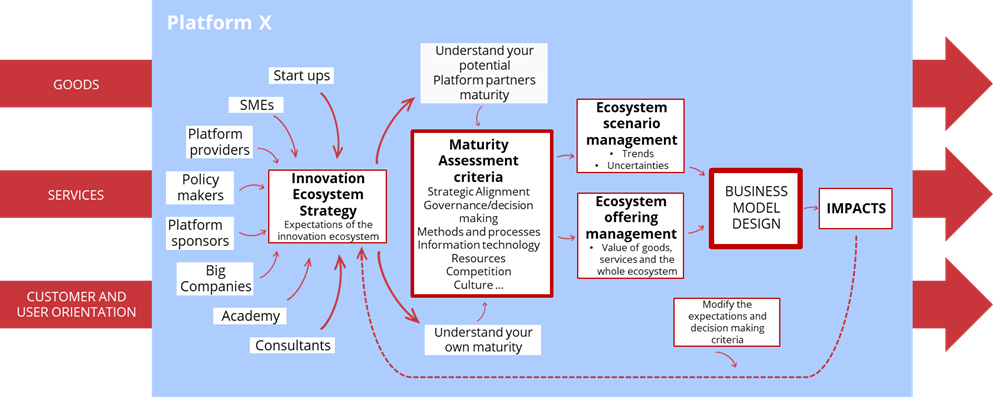
Picture: Aspects of the innovation ecosystem. Adapted from: Berg P. et.al. 2016.
Transparency of the Strategic Platform Ecosystems – Maturity Level Assessment Approach.
Portland Innovation Center for Management of Engineering and Technology, PICMET 2016, Conference.
“Technology Management for Social Innovation”. September 4 – 8, 2016. USA.