
How can understanding the human mind lead to new business? Cognitive science brings together psychology, neuroscience, computer science and other disciplines to understand how intelligent systems perceive, learn, decide and act. But this knowledge does not remain in science. From Nobel Prize 2024 winner Geoffrey Hinton’s pioneering work on neural networks to adaptive systems and biologically inspired robotics, ideas about human and biological intelligence have contributed to technologies with remarkable commercial potential.
How cognitive science becomes technology — and technology becomes opportunity
In 2024, Nobel laureate Geoffrey Hinton warned about the potentially existential risks of artificial intelligence at the University of Oxford. Philosopher Carissa Véliz asked him an intriguing question. If he really believed AI could be so dangerous, and he had played such an important role in developing it, what would he do differently if he could start again?
Hinton’s answer was striking: “I wouldn’t do anything different. Je ne regrette rien, as the song goes.” (Véliz, 2026, p. 182). Whatever one thinks about the risks of AI, Hinton’s story illustrates something remarkable about cognitive science.
Research motivated by a fundamental question — how does cognition work? — can eventually transform technology, industries and business.
What is cognitive science?
Cognitive science is the interdisciplinary scientific study of the mind and intelligence. It combines perspectives from psychology, neuroscience, computer science, linguistics, philosophy and related disciplines to understand mental processes such as perception, learning, memory, reasoning, decision-making and action (Thagard, 2005).
But cognitive science goes beyond describing human thought. One of the field’s great ambitions has been to discover principles of intelligence that can also be formalized and implemented in machines.
Two Nobel laureates illustrate this unusually well.
Herbert A. Simon, awarded the Nobel Prize in Economics in 1978, challenged the assumption of economic decision-maker with complete knowledge and unlimited computational capacity. His theory of bounded rationality (Simon 1955 [Behavioral Model of Rational Choice | The Quarterly Journal of Economics | Oxford Academic]) showed how human decision-making must adapt to limited cognitive resources.
Geoffrey Hinton provides an even more dramatic example.
Hinton began with experimental psychology at Cambridge and completed his PhD in Artificial Intelligence at Edinburgh. His career subsequently crossed psychology, computer science and computational neuroscience. From 2013 to 2023, he also worked half-time at Google. [U of T Computer Science]
In 2024, Hinton received the Nobel Prize in Physics with John Hopfield for “foundational discoveries and inventions that enable machine learning with artificial neural networks.” The Nobel committee explicitly describes artificial neural networks as originally inspired by the structure of the brain. [Nobel Prize]
One crucial milestone came in 2012, when Alex Krizhevsky, Ilya Sutskever and Geoffrey Hinton (2012 [ImageNet Classification with Deep Convolutional Neural Networks] demonstrated that a deep convolutional neural network could achieve dramatically improved performance in large-scale image classification. That work became one of the landmarks of modern deep learning and helped establish the technological trajectory that eventually led to today’s generative AI.
The same journey extends far beyond AI
Cognitive science has long been applied to areas such as human–computer interaction, decision-making and safety. Today, its potential applications extend increasingly to AI, automation, autonomous systems and robotics.
Robotics provides a particularly interesting example.
Research into how biological organisms control their movements can provide principles for designing machines. Keino, Sivén and Suomala (2026 [An analog robot that resembles the human mind | Laurea Journal], building on the work of Barter and Yin (2021 [Achieving natural behavior in a robot using neurally inspired hierarchical perceptual control – PubMed]), discuss a four-legged robot based on hierarchical perceptual control. It continuously uses feedback to maintain controlled variables such as posture and movement despite disturbances. The approach illustrates how principles derived from biological behaviour can be implemented in artificial systems.
A related engineering tradition can be found in adaptive control. Nhan Nguyen’s Model-Reference Adaptive Control describes adaptive control principles and their aerospace applications. Nguyen developed adaptive-control methods that were selected by NASA for flight testing on an F/A-18A research aircraft (Nguyen, 2018 [Springer Nature Link]).
These are technically very different approaches. But they share an important idea: intelligent systems must function effectively in familiar, recurring situations while also adapting to changing and uncertain conditions.
Cognitive science meets AI — again
The relationship between cognitive science and technology is becoming even closer in the current AI era.
At the 48th Annual Meeting of the Cognitive Science Society in Rio de Janeiro in July 2026, researchers presented work ranging from human cognition to large language models, vision-language models and human–AI interaction. [CDL Repositories]
This represents an interesting reversal. For decades, researchers used computers to build models of human cognition. Now cognitive scientists are also using their knowledge of human cognition to understand, evaluate and improve artificial intelligence.
Questions such as Can an AI system reason? Does it know when it is uncertain? Can it adapt its behaviour? How does its performance differ from human cognition? are simultaneously scientific questions and increasingly important technological and commercial questions.
The border between cognitive science and technology development is becoming increasingly porous.
Technology is not yet business
There is, however, an important step missing.
A scientific discovery is not automatically an innovation. A technological breakthrough is not automatically a business.
A neural network, a new robot architecture, an adaptive control algorithm or a new understanding of human behaviour may open an enormous space of possible applications. But somebody still has to answer:
What problem should we solve with it — and for whom?
This is where technological possibility meets innovation.
The commercial possibilities created by AI, robotics, automation and cognitive technologies are enormous. But the larger the technological opportunity space becomes, the more important it is to identify where genuine customer value can be created.
From possibility to business opportunity
This is also where Innoman’s approach comes in.
New technologies rarely arrive with a ready-made business model attached. Companies need to explore alternative applications, understand customer needs, develop concepts, test assumptions and construct viable business models around emerging technologies.
Cognitive science offers a particularly powerful example of this process.
The technologies may be very different, but the business question is ultimately the same:
What new value can we create from what we now know?
That is the point where science becomes innovation — and where technological possibilities can become new business.
How can Innoman help?
Turning technological possibilities into business opportunities requires a systematic process. Innoman helps companies identify promising applications, understand customer value, develop new concepts and build viable business models through services such as NeuroPath™ and InnovationPath™.
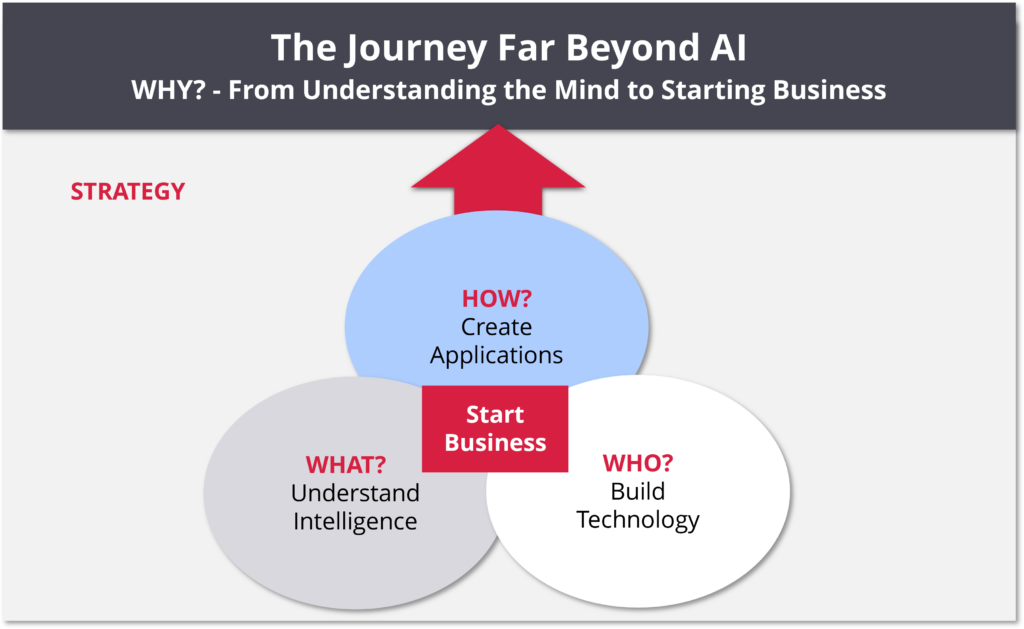
Picture. NeuroPath™ increases understanding of how people can from understanding the mind to start new businesses.
References:
Barter, J. W. & Yin, H. H. (2021). Achieving natural behavior in a robot using neurally inspired hierarchical perceptual control. iScience, 24 (9), 102948.
Cognitive Science Society. (2026). Proceedings of the Annual Meeting of the Cognitive Science Society (Vol. 48). University of California, Merced. Proceedings of the Annual Meeting of the Cognitive Science Society
Keino, L., Sivén, S. & Suomala, J. (2026, April 16). An analog robot that resembles the human mind. Laurea Journal. An analog robot that resembles the human mind | Laurea Journal
Krizhevsky, A., Sutskever, I. & Hinton, G. E. (2012). ImageNet classification with deep convolutional neural networks. Advances in Neural Information Processing Systems, 25, 1097-1105.
Nguyen, N. T. (2018). Model-Reference Adaptive Control: A Primer, Springer. https://doi.org/10.1007/978-3-319-56393-0
Simon, H. A. (1955). A Behavioral Model of Rational Choice. The Quarterly Journal of Economics, 69(1), 99-118. https://doi.org/10.2307/1884852
Thagard, P. (2005). Mind: Introduction to Cognitive Science, (2nd ed.). MIT Press.
Véliz, C. (2026). Prophecy: Prediction, power, and the fight for the future, from ancient oracles to AI. Doubleday.