
Today’s turbulent business environment requires constant change from companies. These requirements are not limited to products or services. They extend to processes, business models, and above all, people.
The Human Side of the Change Paradox
We seek stability while at the same time longing for change. Because we dislike uncertainty, we try to make the future as safe and predictable as possible. The paradox is that without change, we become frustrated and disengaged.
The experience of security is therefore not the opposite of change but a prerequisite for it. Only when people feel psychologically safe can they truly engage in renewal, experimentation, and innovation.
Schumpeter’s view: change is not optional
Joseph Schumpeter, a professor at Harvard from 1932 to 1950, was one of the most influential economists of the 20th century, argued that capitalism is not a system of stability but a process of continuous transformation. As he famously described, economic reality is fundamentally about a dynamic process rather than a static equilibrium (Schumpeter 1928: The Instability of Capitalism. https://doi.org/10.2307/2224315).
At the core of this process is innovation. But for Schumpeter, innovation is not just about ideas or inventions. It is about putting new combinations into practice. In other words, using resources in ways “hitherto untried” and creating real impact in the market.
This leads to what he later called creative destruction: new solutions continuously replace old ones, reshaping industries, business models, and entire markets (Schumpeter 1942: Capitalism, Socialism and Democracy).
Importantly, this process is not smooth or predictable. Innovation is discontinuous because it comes in waves, disruptions, and shifts. It creates opportunities, but also uncertainty, resistance, and even fear. The instability we try to avoid is actually the very mechanism through which progress happens.
Amabile’s view: Innovation is not about creative people only
Teresa Amabile, a professor at Harvard since 1980, brings an important perspective to this discussion. She emphasizes that creativity alone is not enough because innovation requires implementation (Amabile 1988: A Model of Creativity and Innovation in Organizations).
For ideas to become real innovations, organizations must support three key dimensions:
- Expertise and skills – people must have the knowledge and capability to solve problems
- Creative thinking – the ability to see new connections and possibilities
- Motivation – especially intrinsic motivation, the drive to engage and persist
In addition, successful innovation requires the right environment:
- Resources (time, tools, funding)
- Collaboration and trust
- Leadership that enables, not controls
Amabile’s work complements Schumpeter. Schumpeter explains why innovation drives change, while Amabile explains how organizations can make it happen.
The real challenge: aligning change and human experience
Because change is constant, every company needs a clear innovation strategy. This strategy should not only focus on technologies or ideas, but on how the organization enables people to act within change.
One of the most critical success factors is ensuring that people feel safe during continuous transformation.
An innovative company succeeds not only because it has creative individuals, but because it can provide meaningful roles for different types of people. Innovation is a collective capability.
As also highlighted in recent discussions around AI and business model innovation, the key challenge for organizations today is not what is technologically possible, but whether their structures, capabilities, and culture can support implementation.
Too often there is a gap between ambition and reality:
- Leaders want transformation
- Organizations are not ready to execute it
Bridging this gap requires both strategic clarity and human understanding.
How Innoman can help
At Innoman, we believe that successful innovation happens at the intersection of strategy, capability, and human experience.
We help organizations to:
- Build innovation strategies that fit their business reality
- Align business models, processes, and capabilities
- Strengthen the human side of change — motivation, roles, and psychological safety
With solutions like NeuroPath and InnoPath, we bring new ways to understand how people experience change and how organizations can support them more effectively.
Because in the end, innovation is not just about ideas or technology.
It is about people and their ability to act, adapt, and create something new in an uncertain world.
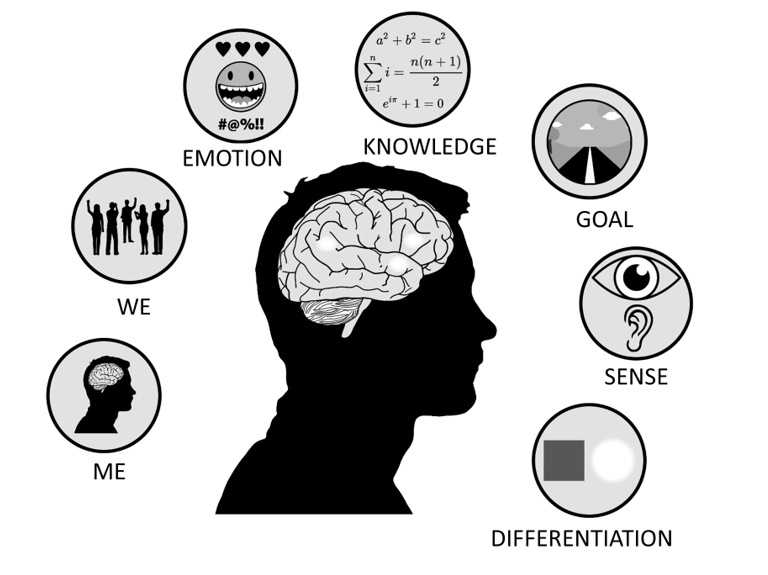
Picture. NeuroPath increases understanding of how people can be helped to experience a sense of meaningfulness in uncertain change situations.