
The place for sales in the innovation process is not at the very end, but right from the front-end, working together with product development, service development, technology, marketing, and business management.
Front-End Challenge
When a new technology, product, or service is trying to find its place in the market, sales does more than just deliver a finished solution to customers. It helps understand where customer value is created, how it can be increased, and what the customer is actually willing to pay for.
In the innovation process, sales acts as a sensor for customers and markets. It identifies new needs, use cases, customer segments, and business opportunities—even when customers themselves cannot yet put them into words.
Solution: Open-Minded Sales for Customer Value
The challenge with a new product is not always the technology itself, but a view that is too narrow regarding its purpose or target group. The essential thing is to understand what the customer is trying to achieve that is not currently working, and how that problem could be solved in a new way.
Furthermore, a customer does not always need a new product. Sales may notice that it is worth building a service around the product, or that it would be more valuable for the customer to buy the final outcome rather than a single product. At the same time, this may reveal a need to renew the commercial model: choosing continuous service, usage-based pricing, or a comprehensive solution instead of a one-time sale.
Innovation can therefore also mean a new way to produce, offer, and monetize customer value.
The task of sales is not just to sell innovations, but to help the organization identify what kind of innovations are worth pursuing.
Cross-Functional Teams Turn Observations into Innovations
The strength of a successful innovation process lies in an effective cross-functional team that combines customer understanding with technical feasibility, service design, and business goals.
Sales brings the customer and market perspective to the team. Product development and technology assess feasibility, service development evaluates the customer experience, and business management analyzes the commercial potential.
This is how a customer observation can lead to a new product, service, use case, or a completely new business model.
Serendipities Turn into Innovations Through Collaboration
A valuable innovation can be born unexpectedly. A customer might talk about a problem where current technology could be applied in a new way. A salesperson might notice that a customer uses the service in a manner the company had never thought of.
This can be described as serendipity—a lucky coincidence where an unexpected observation leads to a valuable insight.
Sales has a special role here. Salespeople constantly encounter different customers, industries, and problems, which is why they clash with phenomena that the rest of the organization does not see. However, serendipity does not mean mere coincidence or luck, but the ability to notice a surprising thing and understand its value. A coincidence sparks the observation, but curiosity recognizes its value, and a functional organization gives it the chance to develop into an innovation.
The salesperson’s task may simply be to say: “This customer is using the solution in a completely different way than we thought. Should we investigate if there could be something bigger here?”
Therefore, what is essential is not just the quantity of new ideas, but the ability to identify interesting anomalies and quickly bring them to the right cross-functional team for investigation and experimentation.
How Can Innoman Help?
You don’t have to build innovation activities alone. Innoman helps organizations develop their innovation process so that observations coming from customers, sales, and the rest of the organization systematically turn into new solutions and business.
In practice, this can mean, for example, building an innovation process and model, facilitating cross-functional development teams, and bringing customer and user understanding into a core part of innovation. Innoman’s innovation services also focus on productization, business models, and evaluating business benefits.
A particularly interesting perspective is the combination of sales and innovation activities: how observations born out of customer encounters in sales can be made a part of the organization’s joint development, and how serendipity—a lucky coincidence—can be made possible without leaving innovation to pure chance.
Innoman can act here as an external facilitator and sparring partner: helping to build an operating model where an observation is identified, the idea is refined, the solution is tested with the customer, and a functional concept is driven towards commercialization (see Innovation Path™).
The goal is not just to get more ideas, but a better ability to identify the right opportunities and turn them into customer value and profitable business.
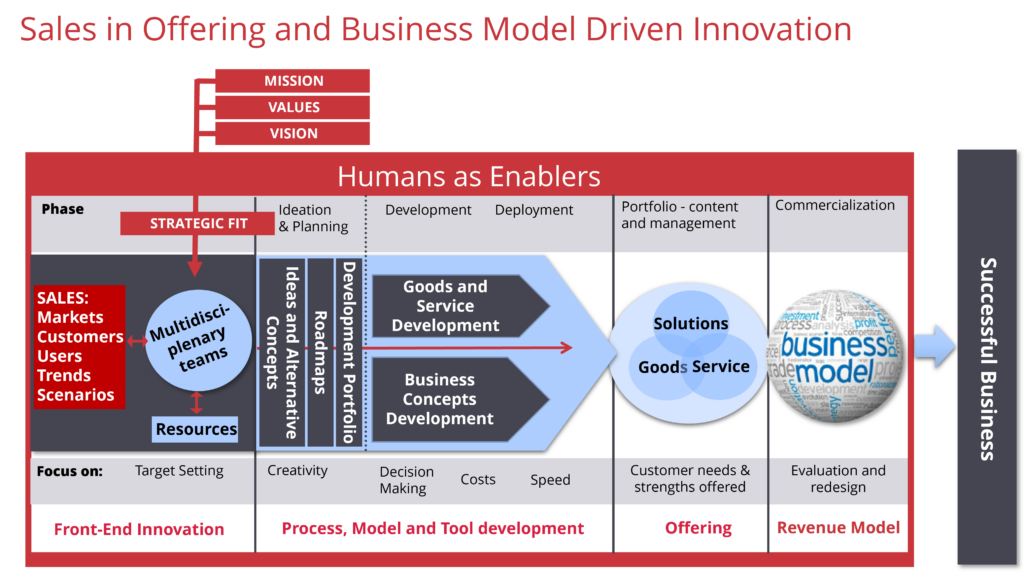
Picture: The Role of Sales as a Radical Driver of Innovation.